A direct booking platform lets property managers take reservations directly from guests, bypassing OTA commissions. The best platforms combine a branded booking website, channel manager, payment automation, and a referral network for sold-out dates, so operators capture more revenue, own the guest relationship, and scale without rebuilding their tech stack each time.
If you run a short-term rental business, you already know the trade-off: OTAs deliver bookings, but they charge handsomely for them, hide your guests behind their branding, and quietly trade your direct demand for theirs. A direct booking platform is the way out.
The term covers more than a booking widget on your homepage. A modern direct booking platform is the entire stack that lets you take reservations on your own terms — your branded site, your payment flow, your guest data, and increasingly, a network of fellow operators who can absorb the demand you cannot fulfil yourself. Done right, it shifts the balance of your business away from third-party platforms and back toward sustainable, owned growth. We will walk through what one really looks like in 2026, why the conversation has moved beyond “build a website,” and how to choose a setup that grows with you.
For a deeper dive on the tactics that turn traffic into bookings, see our companion piece on practical strategies to drive more direct bookings. We will reference it where relevant throughout.

Table of Contents
What is a direct booking platform?
A direct booking platform is the combined set of tools that let a property manager or host accept guest reservations without paying commission to an OTA. At minimum, that means a branded website, a real-time booking engine, integrated payments, and synchronised availability with whatever other channels you list on. In practice, the better platforms now also include automated guest messaging, dynamic pricing, online check-in, cleaning and task workflows, and — the newest layer — a referral network that turns sold-out dates and surplus enquiries into commissionable revenue rather than lost demand.
The distinction matters. A standalone booking widget will technically take a booking. A direct booking platform turns those bookings into a repeatable, scalable channel that competes with the OTAs on convenience while keeping the margin and the guest relationship in your hands. Zeevou empowers modern property managers to reclaim that control, automate confidently, and grow sustainably — which is the lens we will use throughout this guide.
Why the OTA-only model is no longer enough
OTAs still drive volume, but operators relying on them exclusively run into three structural problems. The first is cost: based on publicly available pricing, OTA commissions typically sit between 15 and 25 percent of booking value, before card processing fees. The second is fragility: a single ranking-algorithm change, account suspension, or policy update can wipe out a month of revenue overnight. The third is anonymity — you serve the guest, but the OTA owns the relationship, the data, and the future booking.
A well-built direct booking platform does not replace OTAs; it rebalances them. Your channel manager keeps your inventory live where guests still search, while your direct site captures the lower-funnel intent of guests who already know you, your repeat guests, and the warm leads from social, email, and referrals. Over time, the share of revenue that flows through your direct stack grows, and your dependence on any single channel shrinks.
What does a modern direct booking platform actually include?
If you are evaluating tools today, expect any serious platform to bundle the following layers. Anything missing should be a red flag, not a future add-on you’ll pay for separately.
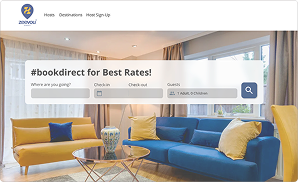
- A branded booking website with a real-time engine — guests see live availability and can book without leaving your site. Zeevou’s direct booking website is built for exactly this, with no commission per reservation.
- A two-way channel manager that keeps your direct site, OTAs, and any third-party listings synchronised. Without this, you will double-book — or hide rooms unnecessarily.
- Integrated payments — saved cards, deposits, security holds, refunds — without bouncing guests to a separate processor.
- A unified inbox so messages from email, OTA platforms, and your own site land in one place, with templates and automated replies for routine questions.
- A property management system to coordinate cleaning, check-in, owner statements, and reporting from one source of truth.
- Dynamic pricing or rules-based pricing so your direct rates remain competitive without needing manual updates every week.
- A referral or operator network that turns sold-out dates and unfit enquiries into revenue rather than lost opportunities.
How a network changes the direct-booking equation
The conventional wisdom on direct bookings stops at “drive more traffic to your site, convert better, repeat.” That advice is still correct — but it leaves money on the floor in two predictable scenarios: when you are sold out on the dates a guest wants, and when an enquiry comes in for a property type you don’t operate. Both of these are warm, qualified demand. Both, until recently, ended in a polite “we’re full, please try elsewhere.”
A networked direct booking model fixes that. Instead of declining the booking, you refer the guest to another vetted operator on the same network — and earn a commission on the resulting booking. The reverse is also true: when other operators in the network can’t fulfil their demand, your inventory becomes their answer. The net effect is a continuous flow of warm referrals between trusted operators, in addition to your own direct bookings. We cover this dynamic in more depth in our guide to handling overbookings and sold-out dates.
For operators trying to expand without the capital risk of new properties, a network also acts as a low-friction inventory growth channel. You can serve guests in cities you don’t yet operate in, test demand for new markets, and generate revenue from listings that aren’t on your balance sheet. We unpack the growth angle further in our companion piece on scaling a property management company.
Direct booking website vs networked direct booking platform
Most operators start with a basic direct booking website and graduate, sometimes painfully, to a full platform once OTA fatigue sets in. The table below shows the practical differences between the two stages, so you can decide where you really sit.
Direct booking website vs networked direct booking platform
| Capability | Standalone direct booking website | Networked direct booking platform |
| Branded booking site | Yes | Yes |
| Real-time availability and rates | Yes | Yes |
| Channel manager integration | Sometimes (add-on) | Built in |
| Handles sold-out dates | Loses the booking | Refers to another operator and earns commission |
| Inventory growth without buying property | No | Yes — network listings extend your reach |
| Cross-operator referrals (incoming) | No | Yes |
| Suited to portfolio scale | 1–10 properties | Any size, especially 10+ |
How to choose a direct booking platform that grows with you
Picking the right platform is less about feature checklists and more about answering five questions honestly. First: does it cover the whole stack — site, channel manager, PMS, payments, messaging — or will I be stitching tools together? Stitching is fine when you are starting; it gets expensive and brittle as you grow. Second: does it bring me incremental demand, or does it just process the demand I already have? Networked platforms do both; pure booking engines do only the second.
Third: how is it priced? Some tools charge per property, some per booking, some take a cut of revenue. Read the fine print on free tiers — an honest “free” plan should let you operate a small portfolio without paying anything until the platform demonstrably earns its keep. Fourth: how easy is it to migrate to or away from? If you cannot get your guest data, listing content, and booking history out, you are renting your business, not running it. Fifth: who is actually behind the product, and what is their roadmap? Direct booking is not a category that stands still. The right partner is investing in network effects, AI, and the next channel before you need it.
For a structured way to put these questions in front of a vendor, Zeevou’s all-in-one property management system is built around the answers we believe matter, with a free plan that lets you run a small operation end-to-end before you commit anything.
Getting started: a practical roadmap
If you are stepping up from OTA-only, the first 90 days look roughly like this. Week one to two: stand up your branded site and connect a channel manager so your direct inventory lives alongside your existing OTA listings without conflict. Week three to four: switch on integrated payments, automated messaging, and online check-in to remove the manual back-and-forth that drags down your margins. Week five to eight: layer on dynamic pricing and unified reporting so you can see direct revenue in context, rather than as a guess against your OTA mix. Week nine onward: tap into your platform’s network — start sending and receiving referrals, and watch the share of bookings that arrive without commission climb.
Don’t try to do all of this on day one. The goal is a stack that compounds — each layer making the next one more valuable — not a wholesale rebuild. Start with the website and channel manager; layer on the rest as your direct share grows.
Conclusion
A direct booking platform isn’t a single tool; it is the set of interlocking layers that let an operator stop renting their business from the OTAs and start running it on their own terms. The right setup pays for itself in commission saved, in guest data captured, and increasingly in the spare-demand revenue that a network turns from a footnote into a real channel.
If you operate any number of short-term rentals and rely heavily on OTAs today, the most useful next step is to look at where your stack sits versus the components in this guide. Even modest changes — a properly connected channel manager, a branded site that actually converts, a network that absorbs your overflow — compound quickly into a healthier, more independent business.
Zeevou is built around exactly this idea: that property managers should own their guest relationships, automate the busywork, and grow without trading control for reach.
Frequently Asked Questions
Q1: What is a direct booking platform for short-term rentals?
A direct booking platform is the combined set of tools that lets you take reservations on your own branded website without paying OTA commission. Modern platforms include a booking engine, channel manager, payments, guest messaging, and increasingly a referral network that captures spare demand.
Q2: Are direct bookings really cheaper than OTA bookings?
Yes. Based on publicly available OTA pricing, commission per booking typically sits between 15 and 25 percent. A direct booking on your own platform avoids that commission entirely, leaving only standard payment-processing fees — usually a small fraction of what an OTA charges.
Q3: Will adding a direct booking platform hurt my OTA visibility?
No. A two-way channel manager keeps your inventory consistent across your direct site and the OTAs, so adding direct bookings doesn’t reduce your OTA exposure. In practice, operators tend to see steady OTA volume and an additional layer of direct revenue on top.
Q4: What happens if I am fully booked on the dates a guest wants?
Without a network, the booking is lost. With a networked direct booking platform, you can refer the guest to another vetted operator and earn a commission on the booking they make. It turns sold-out dates from a dead end into a small but consistent revenue stream.
Q5: Do I need a website builder, or is a booking engine enough?
If you already have a strong website, you mainly need a booking engine that integrates cleanly. If you are starting fresh, look for a platform that includes a branded site builder so design, content, and booking flow are coordinated rather than stitched together from separate tools.
Q6: How long does it take to migrate to a direct booking platform?
Most small operators are live on a basic stack within two weeks: branded site up, channel manager connected, payments enabled. Full automation — messaging, pricing, network referrals — typically lands within a 60 to 90 day window, layered on as you grow comfortable with each piece.
Image by pch.vector on Magnific.