There is no single cheapest OTA — it depends how each platform splits its fee. Airbnb’s host share is low (often around 3%) but adds a large guest fee; Booking.com charges the host a commission near 15%; Vrbo is roughly 8% per booking or a flat subscription. Compare total cost of sale, not the headline rate.
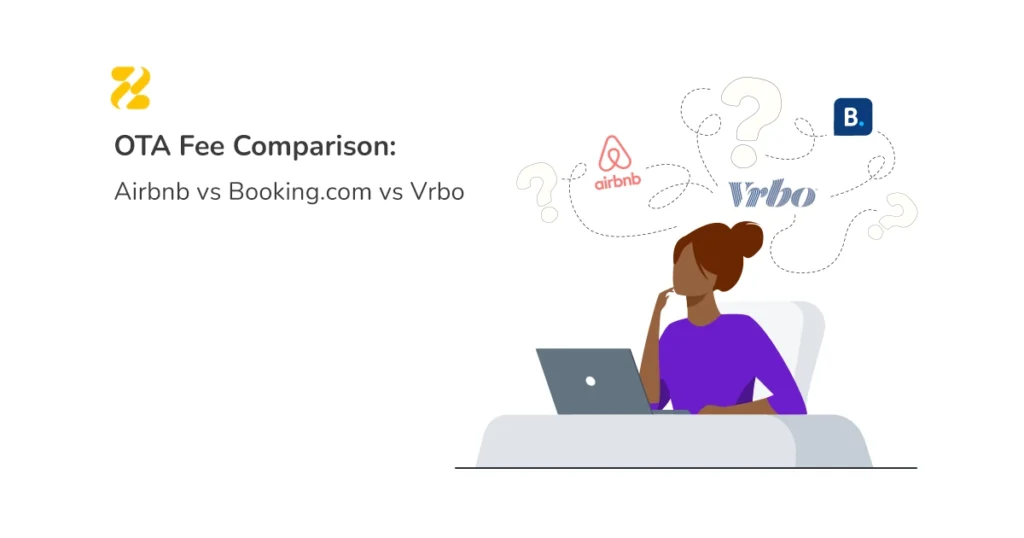
Trying to work out which OTA is cheapest for your vacation rental? The honest answer is that comparing headline percentages will mislead you, because Airbnb, Booking.com and Vrbo each structure their fees in a completely different way — and split the cost between host and guest differently.
This OTA fee comparison puts the three big platforms side by side, explains why a low host fee is not always the cheapest option, and shows you how to compare them on the metric that actually matters: total cost of sale. For the full background on how these fees work, our pillar on OTA fees for vacation rentals sets the scene; this guide is the head-to-head.
All figures are indicative — platforms vary their rates by region and over time — so treat the comparison as a framework, not a fixed quote.
Table of Contents
Airbnb vs Booking.com vs Vrbo: The Fees Side by Side
Each platform answers the question ‘who pays, and how much?’ differently, and that single difference changes which one is cheapest for your property.
Airbnb typically uses a split-fee model: the host pays a small service fee, often cited around 3%, while the guest pays a larger fee at checkout. Booking.com charges the host a commission, commonly cited near 15%, with no separate guest fee. Vrbo offers either a pay-per-booking model of roughly 8% all-in or a flat annual subscription, plus a guest service fee.
The table below lays out the three side by side so you can see at a glance where the cost falls — on you, on the guest, or both.
Why the Lowest Host Fee Isn’t Always Cheapest
On paper, Airbnb’s ~3% host fee looks like the clear winner. But a low host fee paired with a high guest fee inflates the total price the traveller sees — which can hurt your conversion and force you to lower your nightly rate to stay competitive. That pressure is a real cost, even though it never appears on your statement.
Booking.com’s 15% all lands on you, but because the guest sees a price close to your nightly rate, conversion can be stronger. Vrbo sits in between. So the ‘cheapest’ platform is the one with the lowest total cost of sale for your specific property and market — a blend of the fee you pay, the fee the guest pays, and how each affects your bookings.
This is exactly why a like-for-like comparison has to look past the host percentage to the whole transaction.
OTA Fee Comparison: Airbnb vs Booking.com vs Vrbo (Indicative)
| Platform | Who pays | Typical host cost | Guest fee? |
| Airbnb | Split (host + guest) | ~3% host (split model) | Yes — larger guest service fee |
| Booking.com | Host | Commonly cited ~15% commission | No separate guest fee |
| Vrbo | Host (+ guest) | ~8% per booking or flat subscription | Yes — guest service fee |
How to Compare OTAs on True Cost of Sale
To compare platforms fairly, model the total cost of sale per booking rather than the sticker commission. A simple approach works well for most hosts.
For each channel, take a typical booking and add up: the host fee or commission, any payment-processing cost, and an allowance for the conversion impact of the guest-facing price. Then express it as a percentage of your payout. Run the same booking through each platform and the genuinely cheapest channel for your property becomes obvious — and it is often not the one with the lowest headline rate.
Do this once or twice a year, because rates and your booking mix both shift. The platform that was cheapest last season may not be this one.
- Add host fee + payment fee + an allowance for guest-price impact.
- Express the total as a percentage of your payout.
- Run the same booking through each platform to compare like for like.
- Re-check once or twice a year as rates and demand change.

The Channel That Always Wins: Your Own
Whichever OTA comes out cheapest, every one of them still takes a cut. The lowest-cost channel of all is the one you own, where the cost of sale is just your payment processing.
A commission-free direct booking website lets the guests an OTA won you rebook you directly, at full margin. Keep a two-way channel manager in place so your rates and availability stay consistent across Airbnb, Booking.com, Vrbo and your own site — preventing the double bookings that cost more than any commission. Zeevou empowers hosts to compare and use OTAs intelligently while steadily growing a direct, fee-free channel of their own.
Frequently Asked Questions
Q1: Which OTA has the lowest fees for hosts?
It depends on how you measure it. Airbnb has the lowest host share (often around 3%) but adds a large guest fee; Booking.com puts the full commission (commonly ~15%) on the host; Vrbo is roughly 8% per booking or a flat subscription. The cheapest for you is whichever has the lowest total cost of sale for your property and market.
Q2: Is Airbnb really cheaper than Booking.com?
On the host fee alone, yes — Airbnb’s split model means hosts often pay around 3% versus Booking.com’s ~15%. But Airbnb’s larger guest fee raises the price travellers see, which can affect conversion. Compare them on total cost of sale, not the host percentage, to get a fair answer.
Q3: What is total cost of sale for a vacation rental booking?
It is the full cost of acquiring a booking through a channel: the host fee or commission, payment processing, and the indirect effect of any guest-facing fee on conversion, expressed as a percentage of your payout. It is the only fair way to compare OTAs that split their fees differently.
Q4: How can I reduce OTA fees across all platforms?
Use OTAs to win new guests, then move repeat and referred bookings to a commission-free direct booking website where the only cost is payment processing. Keep a channel manager synced across platforms to avoid double bookings, which often cost more than commission itself.
Conclusion
An OTA fee comparison only helps if you compare the right thing. Airbnb, Booking.com and Vrbo each split their fees so differently that the lowest host percentage is rarely the cheapest channel once you account for the guest fee and its effect on conversion.
Model your true cost of sale per platform, re-check it as rates and demand shift, and let the numbers — not the headline rates — decide where each booking should come from. And remember the one channel that always wins on cost: your own direct site, where the OTA takes nothing at all.
Image by pch.vector on Magnific.