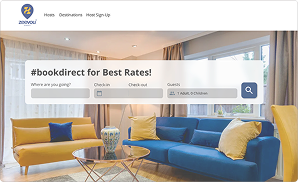
To increase direct bookings, make your booking flow faster than an OTA’s, give returning guests a reason to skip the middleman, and route the demand you can’t fulfil through a referral network. The mix of a frictionless site, repeat-guest incentives, and overflow capture typically lifts direct revenue without hurting OTA volume in the process.
Knowing how to increase direct bookings is the difference between a property business that scales on its own terms and one that pays whatever commission the OTAs decide is fair this year. The work isn’t glamorous, but it’s also not complicated — most operators leak direct revenue at three predictable points: a slow or confusing booking flow, a missed second booking from a guest who already loves the place, and the demand they outright lose when they’re sold out.
This piece is about closing those three leaks. We assume you already have the basics — a branded site, a working channel manager, integrated payments — and want to push the share of bookings that arrive without commission. If you don’t yet, start with our pillar guide on what a modern direct booking platform looks like and come back here.
A quick framing note: increasing direct bookings doesn’t mean abandoning OTAs. The aim is to add a layer of owned, commission-free demand on top of your existing channels — not pull rooms from anywhere. Done well, your OTA volume stays steady and your direct revenue grows alongside it.
Table of Contents
Why direct bookings matter (and what they’re actually worth)
Every direct booking is a saved commission, a captured guest record, and the start of a relationship you control. Based on publicly available OTA pricing, commissions sit between 15 and 25 percent per booking — meaning a £200/night, four-night stay loses roughly £120–£200 to the OTA before you account for any payment processing. Multiply that across your typical month and the leakage is rarely small.
The second-order benefit is data. When a guest books direct, you keep their email, their preferences, and the right to follow up. When they book through an OTA, you serve the stay but the relationship belongs to someone else — which is why the same guest often “books elsewhere” the second time without realising they could just come back to you.
Make your booking flow faster than the OTA’s
The first leak is friction. If a guest takes longer to confirm a stay on your site than on Booking.com or Airbnb, you’ve already lost. Three things tend to fix this without a redesign:
- Real-time availability and rates on the listing page — not on a quote-request form. Use a direct booking website connected to your PMS so prices and dates update without a page reload.
- One-page checkout — guest details, payment, and confirmation in a single flow. Every redirect and form-page loses a noticeable share of bookers.
- Trust signals at the booking step — verified reviews, a real cancellation policy, a photo of the host or operator. Guests who know your name still hesitate at “is this site legitimate?” without these cues.
Give returning guests a reason to skip the middleman
Most operators dramatically under-invest in repeat bookings, which is strange because returning guests are the cheapest demand you have. After a stay, you already have permission to email — use it. A simple post-stay flow works:
- Within 48 hours: a thank-you email with a single “book your next stay” link.
- Within 30 days: a soft offer — a percentage off, a flexible date credit, a free upgrade — for booking direct, not via the OTA.
- Quarterly: relevant reasons to come back — seasonal availability, a new property in the same area, a partner property in a city they’ve mentioned.
Use guest data instead of guessing
If you collect emails, dates, and guest preferences, you can stop guessing about what your audience wants. Use automated messaging to send segmented offers — a different message to first-time bookers than to your repeat audience, a different message to corporate stays than to families. None of this needs to be expensive marketing-team work; it just needs the underlying guest record to actually live somewhere usable.
The table below shows where each direct-booking lever typically lands, so you can prioritise based on your stage.

Direct booking levers ranked by typical impact and effort
| Lever | Typical effort | Typical impact |
| Faster, real-time booking flow | Low–medium | High |
| Post-stay repeat-guest emails | Low | Medium–high |
| Segmented offers via guest data | Medium | Medium |
| Network referrals for sold-out dates | Low (once joined) | Medium, compounding |
| Paid search and metasearch | High | Variable |
| Loyalty programme | High | Long-term |
Capture the demand you can’t fulfil with a network
Even with a perfect site and perfect repeat flows, you’ll still lose bookings on dates where you’re already full or for property types you don’t operate. Without a network, those leads disappear. With a referral network, you can pass the guest to a vetted operator nearby and earn a commission on the booking they make. The reverse is also true — when other operators in the network can’t fulfil their demand, your inventory is what they recommend. Zeevou empowers property managers to keep that overflow demand inside the network, rather than handing it back to the OTAs by default. We go deeper on the mechanics in our pillar piece on the modern direct booking platform.
Conclusion
Increasing direct bookings is mostly about removing friction and capturing demand you’d otherwise leak. Make the booking flow faster than the OTAs, talk to past guests like they’re worth keeping, use what you already know about them to send relevant offers, and build a way to monetise the demand you can’t fulfil yourself.
None of this requires a marketing department or a six-figure budget. It does require the underlying tools to be connected — your site, your PMS, your messaging, and your network — so that the guest data you capture actually drives the next booking. That’s what a modern direct booking platform is built to do.
Frequently Asked Questions
Q1: How much can I realistically increase direct bookings by?
Operators who fix the booking flow and add repeat-guest emails commonly see direct share grow by a few percentage points per quarter, compounding over a year. The exact gain depends on your starting point, brand awareness, and how well your OTA listings already convert traffic to your site.
Q2: Will offering direct discounts cannibalise my OTA bookings?
Not usually. Most direct-booking incentives are framed as exclusive to your site — perks, flexibility, or small percentage discounts that OTAs don’t allow due to rate parity. Operators tend to see steady OTA volume with an additional layer of direct bookings sitting on top.
Q3: Do I need a separate website builder to increase direct bookings?
Only if your current site is the bottleneck. If your existing site converts poorly, has slow load times, or doesn’t show real-time rates, a purpose-built booking site will move the needle quickly. If your site already works, focus on repeat-guest flows and overflow capture first.
Q4: What should I do when a guest enquires about dates I’m fully booked?
Don’t just decline. Refer them to another operator on a network you trust — you keep the relationship warm and earn a commission on the resulting booking. A referral network turns sold-out dates into a small but consistent revenue stream rather than dead leads.
Q5: How quickly will I see results from these changes?
Frictionless booking flow improvements often show up in conversion data within weeks. Repeat-guest email flows take a stay-cycle or two — typically 30 to 90 days — to start producing visible volume. Network referrals begin almost immediately once you connect to a network.
Q6: Do I need a loyalty programme to increase direct bookings?
Not at the start. Loyalty programmes are powerful at scale but heavy to operate. Most operators see better near-term gains from fixing checkout friction, sending well-timed post-stay offers, and capturing overflow demand — none of which require a formal loyalty scheme.
Image by pch.vector on Magnific.