

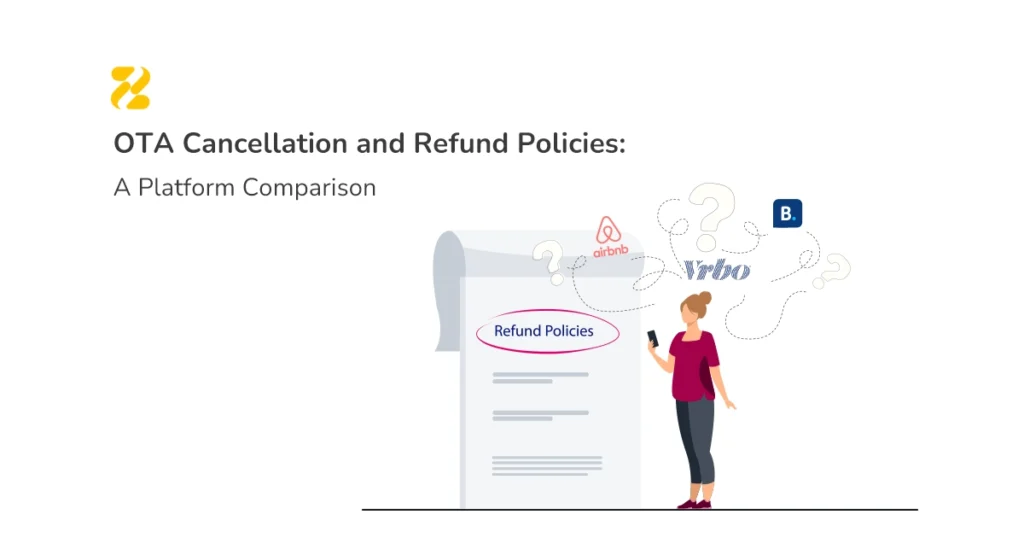
Guests rarely read the fine print until they need to cancel, and every major OTA handles that moment differently. Here’s how Airbnb, Vrbo and Booking.com compare on cancellation windows, who absorbs the refund, and where hosts carry the risk.
Table of Contents
Cancellation windows
Airbnb runs on host-selected policy tiers, Flexible, Moderate, Firm and Strict/Limited, so the refund window changes property by property. A Flexible listing refunds in full up to 24 hours before check-in; Strict policies can lock in nonrefundable terms well in advance, which is where Airbnb’s refund mechanics start to matter most for hosts.
Vrbo also lets hosts choose a cancellation policy (Relaxed through Strict), but its tiers are built around days-before-arrival cutoffs rather than Airbnb’s named tiers, which makes direct comparison easy to get wrong.
Booking.com defaults most listings to free cancellation up to a set date, with hosts opting into non-refundable rates for a lower displayed price, shifting more of the cancellation risk onto the guest, but only when the host actively chooses that rate type.

Who refunds the guest
On all three platforms, the platform processes the refund to the guest, but the host absorbs the booking loss: the money simply isn’t paid out, or is clawed back if already paid. None of the big three OTAs cushion the host’s lost revenue. “Platform protection” programmes, like Airbnb’s AirCover or Booking.com’s Partner Liability Insurance, cover narrower cases such as no-shows or property misrepresentation, not standard guest cancellations.
Where hosts actually lose money
The real exposure isn’t the refund itself, it’s the unsold night. A cancellation inside the free-cancellation window with no rebooking is a 100% revenue loss on that date, and the shorter the notice, the worse the odds of refilling it. This is true across all three platforms; the policy tier only changes how early the host finds out.
The bottom line
Policy wording differs across Airbnb, Vrbo and Booking.com, but the underlying risk doesn’t: hosts carry the cost of unsold nights, not just refunds. For the specifics on managing that risk platform by platform, the guides above cover each one in detail.
Image by pch.vector on Magnific.