
booking can be confirmed. A guest can check in. A host can even receive a payout notification.
And the payment can still not be secured.
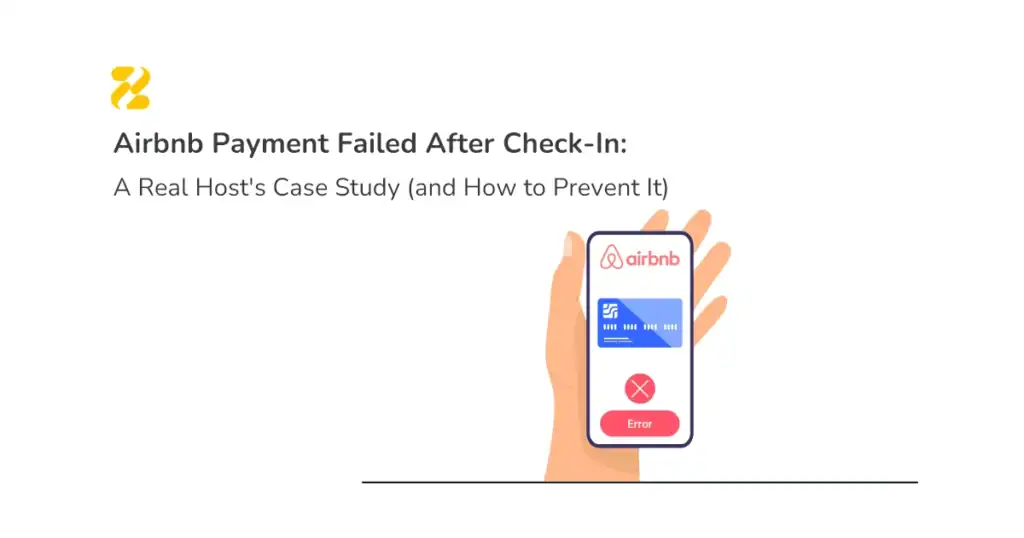
That’s exactly what happened to a short-term rental host who described the situation in a BiggerPockets forum post. The guest had booked 28 nights, checked in, and was already on their fourth night when Airbnb flagged a problem collecting payment. The guest cancelled that same evening.
For a property manager, the uncomfortable question isn’t “why did the payment fail?” It’s: why was the booking allowed to progress this far before anyone knew?
Table of Contents
What Actually Happened
Bian Dahab, the host, posted about it on BiggerPockets in December 2023:
| Date | Event |
| Mid-November | Guest books 28 nights under a strict cancellation policy. Booking is confirmed. |
| 2 December | Guest checks in. |
| 4 December | Host receives a payout notification. |
| 5 December, 4:26 PM | Airbnb notifies the host of a problem collecting payment. |
| 5 December, 4:35 PM | Guest asks whether they can cancel. |
| 5 December, 9:22 PM | Guest cancels the reservation. |
The host wasn’t upset about the guest wanting to leave, they said as much explicitly. What actually unsettled them was a line Airbnb sent alongside the payment alert: if a guest doesn’t complete payment, or cancels before paying, Airbnb has no obligation to issue the host’s payout at all. Four nights into an active stay, that’s not a minor disclaimer.
This isn’t a one-off glitch, either. According to Airbnb’s own Payments Terms of Service, stays of 28 nights or more are charged in recurring installments rather than one lump sum, and if a scheduled charge fails, the guest gets 72 hours to fix it before Airbnb can cancel the booking on their behalf. In other words, this mechanism is a documented, built-in part of how Airbnb handles long stays, any host or property manager running 28+ night bookings is exposed to the same gap.

The Real Issue: Booking Status Isn’t Payment Status
A confirmed reservation only answers one question: is there a booking? It doesn’t answer whether the money behind it has actually been collected. In this case, the host had no visibility into that second question until Airbnb sent an after-the-fact alert.
That gap matters because operators act on booking information before payment is verified – paying owners, scheduling cleaners, buying supplies, staffing up – all against revenue that may not exist yet. The safer default: don’t treat a reservation as financially secure just because it exists in the system.
Why This Matters More at Scale
For a single host, this gap is stressful but contained. For a property management company running dozens or hundreds of units, it multiplies – a handful of unnoticed Unpaid bookings can mean owner statements built on revenue that isn’t there yet, cleaning crews paid against turnovers that were never confirmed, and no one whose job it is to catch it, because each booking looks fine on its own. At scale, the fix isn’t catching the problem – it’s making it visible by default across every reservation.
How Zeevou Closes That Gap
A payment-aware PMS treats payment status as its own tracked field instead of something buried inside the OTA’s dashboard. Here’s what that looks like in practice with Zeevou.
For OTA bookings, Zeevou tags every reservation as Channel Collect or Host Collect from the moment it comes in, using its automated payments workflow to track whether the channel’s virtual card details are in place and whether a charge is scheduled, pending, or has failed well before the guest checks in.
Every booking shows a live status of Paid, Partially Paid, Unpaid, or Credit, so nothing is hiding behind a “confirmed” label. If a charge fails or card details are missing, the booking is flagged for manual follow-up immediately rather than waiting on a downstream notification from the channel. Mapped onto this exact case: the operator would have known about the payment problem on the morning of 5 December instead of finding out at 4:26 PM after four nights had already passed with enough time to reach the guest before the guest cancelled first.
For direct bookings, Zeevou can go a step further and prevent the gap outright. With an integrated payment gateway, guests are required to complete payment before their booking is confirmed and the calendar is blocked, using Zeevou’s booking engine to handle the request end to end. If payment isn’t completed in time, the request simply expires instead of sitting on the calendar as a confirmed-but-unpaid reservation, the direct-channel version of this exact scenario simply not being able to happen.
And once a booking is flagged as anything other than Paid, follow-up isn’t manual guesswork: an Unpaid booking can trigger a reminder, and a Partially Paid one can get a partial payment link for the outstanding balance sent straight to the guest.
The Bigger Lesson
Picture this inside a multi-property business rather than a single host account: a 28-night booking comes in, the team preps the unit, and books cleaners and owner payouts against the expected revenue. Days into the stay, the payment fails and several financial decisions have already been made against money that was never actually secured.
The fix isn’t distrusting every OTA booking. It’s refusing to treat booking status and payment status as the same signal, and using a PMS that keeps both in one workflow instead of three separate places to reconcile by hand.
Frequently Asked Questions
Is a confirmed Airbnb booking the same as a confirmed payment?
No. A confirmed reservation doesn’t guarantee the payment has been successfully collected as the BiggerPockets case above shows, a host can have an active, multi-night reservation and only learn about a payment problem after the fact.
What happens if an Airbnb guest’s payment fails after check-in?
It depends on the booking type, but for 28+ night stays specifically, Airbnb’s payments terms give the guest 72 hours to fix a failed payment before the booking can be cancelled on their behalf exactly the window an operator wants visibility into, not a surprise notification after the fact.
How does Zeevou track OTA payments differently than the OTA dashboard does?
By separating Channel Collect from Host Collect at the booking level and updating each reservation’s status – Paid, Partially Paid, Unpaid, or Credit – the moment a charge succeeds, fails, or is missing required card details.
Can Zeevou stop an unpaid direct booking from blocking the calendar?
Yes. The direct booking flow can require payment completion before a booking is confirmed and dates are blocked; requests that aren’t paid in time simply expire.
Why does this matter beyond revenue reporting?
Because operators commit real costs – owner payouts, cleaning, staffing – based on expected booking revenue. If that revenue was never actually secured, the team made those decisions on an assumption rather than a fact.
Image by pch.vector on Magnific.