
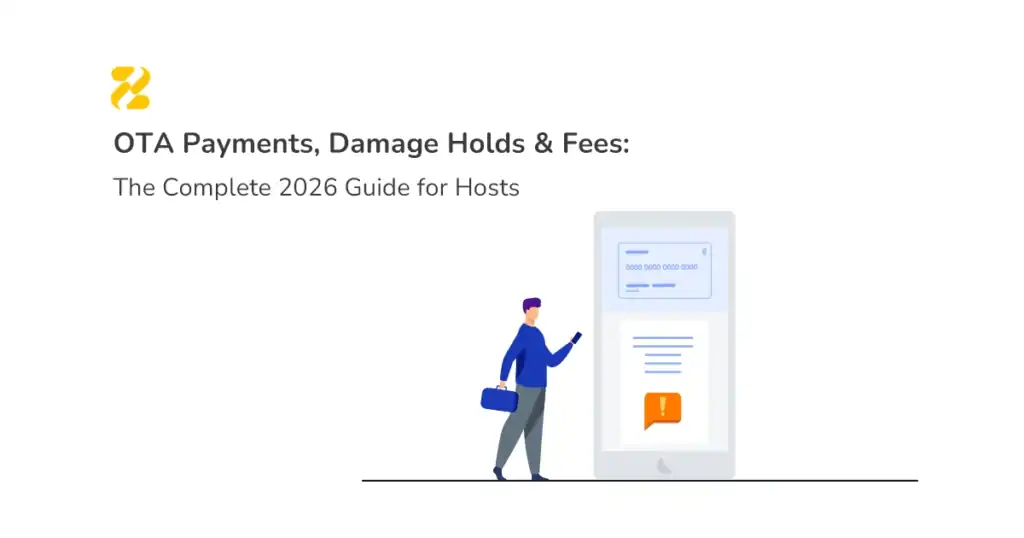
Expedia, Booking.com and Airbnb each use a different payment model, a different approach to damage holds, and a different fee structure. For hosts listing on all three at once, that means three rulebooks, not one, and getting it wrong affects cash flow, chargeback risk and how much of the booking value actually reaches you.
This page maps all three platforms in one place, then links out to the detail: virtual cards, deposit holds, service fees and more, wherever you need to go deeper on one specific mechanic.
Table of Contents
Why This Varies By Platform
OTAs sit in different places in the payment chain. Some, like Airbnb, collect payment directly and pay the host out afterwards. Others, like Booking.com, largely leave payment collection to the property, routing the guest’s funds through a virtual card instead. Expedia runs a hybrid model depending on the property’s contract type. That single distinction, who actually holds the guest’s money and when, is what drives most of the confusion hosts run into around fees and damage holds.
Expedia: Payments, Deposits & Fees
Expedia bookings fall into two payout models, plus a separate guest-facing financing option that hosts often mix up with their own payout.
How Hosts Get Paid
Hosts get paid on Expedia through one of three models, set at the property level, not per booking:
- Hotel Collect: the guest pays the host directly, at check-in or checkout.
- Expedia Collect: the guest pays Expedia at booking, and Expedia remits the host’s share afterwards, typically within 30 days of checkout.
- Virtual Card (VCC): a prepaid card Expedia issues for Expedia Collect bookings, which the host charges at checkout in place of a real card.
Guest instalment plans (Expedia’s “Book now, pay later” via Klarna/Affirm) are separate from this: the guest can pay in instalments while the host is still paid in full on the normal payout schedule.
Read more: Expedia Payment Plans 2026: When & How Hosts Get Paid

Damage Holds on Expedia
Expedia does not run its own damage deposit system. Deposit handling depends on the property’s own setup and local law, and is usually collected outside Expedia’s payment flow if collected at all.
Read more: 5 Things to Know about Security Deposits for Vacation Rentals
Fees on Expedia
Expedia charges the property a commission that varies by market and contract type. Guest-facing taxes and fees are itemised separately at booking.
Read more: Boost Bookings: 3 Key Reasons to List Your Property on Expedia
Booking.com: Payments, Deposits & Fees
How Hosts Get Paid
Booking.com typically does not process guest payment itself; it issues the property a virtual credit card (VCC) loaded with the guest’s funds, and the property charges that card directly. That is also why hosts sometimes cannot find real guest card details on a booking.
Damage Holds and Deposits on Booking.com
Booking.com has no single native security-deposit feature. Pre-authorisation, prepayment and damage deposits are three different things, and hosts often conflate them
Read more: Get Rid of The Booking.com Security Deposit Problems Once and for All
Read more: Booking.com Insurance for Hosts: What’s Covered and How It Works
Fees and Fraud Risk on Booking.com
Booking.com charges the property a commission and, in most markets, adds no separate guest-facing service fee. Account-takeover scams that target guest payment details are a live risk worth guarding against.
Read more: Booking.com Commission Rate: What Hosts Really Pay
Read more: Booking.com Scam Prevention Guide for Hosts

Designed by Magnific
Airbnb: Payments, Deposits & Fees
How Hosts Get Paid
Airbnb collects full payment from the guest at the time of booking and pays the host out roughly 24 hours after check-in. Most hosts pay a 15.5% host-only service fee, deducted before payout; a small number of markets and listing types sit outside that standard rate.
Read more: Airbnb Host Fees 2026: Complete Guide to the New Structure
Read more: What We Mean When We Talk about Airbnb Service Fees
Damage Holds on Airbnb
Airbnb has moved away from a separate guest-facing “security deposit” request for most hosts and now relies on AirCover for Hosts, automatic and free for every host: $3m in host damage protection and $1m in host liability insurance.
Read more: Airbnb AirCover: Offer Longer Stays with Peace of Mind
Read more: 3 Common Airbnb Security Deposit Issues and How to Solve Them
Fees on Airbnb
Beyond the host service fee, extra-guest fees and cleaning fees are the two hosts get wrong most often.
Read more: Airbnb Cleaning Fee: Tips and Strategies for Hosts
Read more: Airbnb Cancellation Fees 2026: What Guests & Hosts Pay
Managing Deposits and Payments Across All Your Channels
If you list on Expedia, Booking.com and Airbnb at once, what a guest paid, what you’re owed, and whether a deposit exists follows three different models, not one. Zeevou’s channel manager and automated deposit workflows put that in one system you control, instead of three you reconcile by hand.
Read more: How Automated Security Deposit Helps You Get Rid of Property Management Hassles
Read more: How to Automate Security Deposits for Direct Bookings
Conclusion
There is no single answer to how OTA payments work. It depends on the platform, the collection model, and whether a damage hold applies. This page is the map. Follow the links above for the detail on any one platform or mechanic.
FAQs
How do OTA payments differ between Expedia, Booking.com and Airbnb?
Airbnb collects payment itself and pays hosts out after check-in. Booking.com generally leaves collection to the property, via a virtual card. Expedia uses either model, depending on the property’s contract.
Does Expedia take a damage deposit?
No. Expedia has no native damage deposit system; any deposit is collected by the property, outside Expedia’s own payment flow.
Does Booking.com take a security deposit?
Not as a single built-in feature. Booking.com distinguishes pre-authorisation, prepayment and damage deposits, and any deposit is generally arranged by the property.
Does Airbnb still have security deposits?
For most hosts, no. Airbnb replaced host-requested security deposits with AirCover for Hosts, which gives every host $3m in damage protection and $1m in liability insurance automatically.
What fee does Airbnb charge hosts?
Most hosts pay a 15.5% host-only service fee, deducted from the payout before it reaches the host. A small number of markets and listing types fall outside that standard rate.
What is a Booking.com virtual credit card (VCC)?
A temporary card Booking.com issues per booking, loaded with the guest’s funds, which the property charges directly instead of taking the guest’s real card details.
Image by pch.vector on Magnific.