Every booking that comes through Airbnb or Booking.com hands over a cut of the stay and the guest’s contact details along with it. A direct booking website is how an operator keeps both – the booking engine on their own site, under their own brand, with no commission on the stay and the guest relationship staying with them. This guide covers what a direct booking website actually needs, how to build and grow one, and where it fits against relying on OTAs alone.
The numbers back this up: on a portfolio of 10 properties generating £1 million a year, shifting half of bookings direct and avoiding the typical 18% OTA commission works out to roughly £90,000 in additional profit and that’s before counting the upside from direct bookings cancelling at roughly half the rate of OTA bookings, and the repeat-guest value that comes from owning the relationship instead of re-acquiring guests through an OTA each time.
Table of Contents
What a direct booking website is, and who needs one
A direct booking website is your own branded booking engine: the page a guest lands on when they search for your property by name, or come back after a previous stay, rather than going through Airbnb or Booking.com. It handles availability, rates and payment collection the same way an OTA listing does, but the booking sits on your site, under your brand, and the guest relationship is yours to keep. If you’re setting one up for the first time, our full beginner walkthrough covers the basics in more depth.
What OTA-only distribution actually costs you
Every booking that comes in purely through an OTA carries two costs: the commission on that stay, and the fact that the guest’s contact details stay with the OTA, not with you. That’s not a reason to drop OTAs, since they’re still a genuine source of new guests, but relying on them exclusively means repeat guests keep paying that same commission on every return visit, when a direct channel would let you convert them once and keep them. See the detailed side-by-side for how the two channels actually compare.

What a direct booking website needs to actually work
A branded booking page on its own isn’t enough. A few things need to be right for it to actually convert.
Design and usability
The booking flow needs to work properly on mobile, load quickly, and get a guest from search to confirmed booking in as few steps as possible. Our guide to building a good direct booking website covers the specific design choices that make the difference.
Picking a domain
Your domain is part of how guests find and trust the site: a keyword-relevant, easy-to-spell domain that matches your business name reads as more credible than a generic one, and can help with search rankings too. A few things worth getting right from the start: keep it simple and memorable, avoid numbers or hard-to-spell words, stick to trusted extensions (.com, .net, or your country’s domain), register through a reputable provider, turn on domain privacy protection, and set a renewal reminder so it doesn’t lapse without you noticing.
Taking payments properly
Guests need to be able to pay securely and know clearly what they’re being charged and when. Card payments through a PCI-compliant gateway with 3D Secure are the standard setup, collecting a deposit or full balance ahead of arrival bank transfers work for long stays or repeat guests but are slower to reconcile, and cash should be avoided since it’s hard to trace or refund against. For security deposits, a pre-authorisation or separate refundable hold is cleaner than taking the money outright. Whatever the setup, keep clear records – policy acceptance, check-in logs, guest communications – since that documentation is what protects you if a chargeback comes in.
The tools worth having connected
A few tools consistently pay for themselves fastest: Google Analytics and Search Console to see where bookings are actually coming from and catch indexing or SEO issues, Google Tag Manager to add tracking without needing a developer, and Google My Business so your properties show up in local search and Maps. Beyond analytics, a way to collect guest emails matters just as much, it’s what lets you reach past guests directly next time instead of re-acquiring them through an OTA each visit (see [collect guest emails to boost direct bookings] for how to set that up).
Turning the website into actual bookings
Having the site live is the start, not the finish. Getting real bookings through it comes down to a handful of things working together: a clear strategy for why a guest should book direct rather than through an OTA (see our direct booking strategies), a booking flow that doesn’t lose people partway through (our conversion-rate tips cover this), a plan for actually driving traffic to the site in the first place (more on getting more direct bookings), and the marketing groundwork to support all of it (our property marketing tips).
Comparing your options
Most direct booking engines fall into a few categories: PMS-bundled booking engines (built into the property management system you already use), standalone booking-engine plugins you bolt onto an existing site, and website builders aimed specifically at short-term rental operators. Which one fits depends on how much you want to manage separately – a bundled engine keeps rates and availability in sync automatically, while a standalone tool gives more design freedom but means keeping two systems in step. The right choice usually comes down to how many properties you run and whether you’re happy maintaining a booking engine as a separate piece of software.
Zeevou: an all-in-one PMS with a built-in, commission-free booking engine and SEO-friendly website per brand. Best for multi-property or multi-brand managers who want direct bookings and operations running on one platform.
Boostly: done-for-you WordPress websites built for conversion, with PMS and payment gateway integrations. Best for hosts who want a high-converting site without building it themselves.
Lodgify: a beginner-friendly, drag-and-drop website builder with integrated payments and multi-language support. Best for individual hosts wanting something simple and polished.
Hostaway: a WordPress-based booking site with custom branding, real-time availability, and strong integrations. Best for professional property managers with multi-channel needs.
Uplisting: a clean, one-template booking engine with Airbnb import and OTA sync to prevent double bookings. Best for smaller portfolios looking for simplicity and affordability.
Guesty: AI-powered tools for discoverability and conversion, with a commission-free booking engine and automated guest messaging. Best for property managers with multiple listings needing scale and marketing tools.
Where Zeevou fits
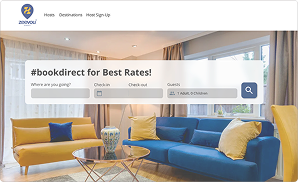
Zeevou includes a direct booking website as part of its platform, giving operators a branded booking engine that stays connected to the same availability and rates used across other channels. It’s offered as a module rather than included on every plan, so availability depends on which plan an operator is on.
Image by pch.vector on Magnific.