Quick answer: A channel manager for Airbnb is software that keeps your rates, availability and bookings in sync across Airbnb, Booking.com, Vrbo and your own website. When a night sells on one channel, it closes on the rest. For UK hosts with more than one listing or channel, it replaces manual calendar updates and prevents double bookings.
If you manage more than one listing across Airbnb, Booking.com or Vrbo, you know the dread of updating three calendars by hand and hoping nothing slips through. A channel manager for Airbnb removes that risk by pushing every sale, rate change and block to every channel from one place.
This guide explains what an Airbnb channel manager does, how API and iCal connections differ, what a UK multi-property setup looks like day to day, and how to choose the best channel manager for Airbnb with a practical checklist. If you would like to see one in action, Zeevou’s Airbnb channel manager connects Airbnb, Booking.com, Vrbo, Expedia, Agoda and Tripadvisor from one dashboard.
It is written for UK hosts and property managers at any scale, from a single Cotswolds cottage to a portfolio spread across London and the Lake District.
Table of Contents
What Is a Channel Manager for Airbnb?
A channel manager is software that sits between your properties and the online travel agencies (OTAs) you list on. You make a change once, such as blocking a date or raising a weekend rate, and it pushes the update to every connected channel automatically.
Airbnb does not sell a channel manager itself. Its help centre describes channel managers as software that lets hosts centralise availability and pricing, and lists approved partners. In practice you authorise the software on your Airbnb account, map your existing listings to it, and from then on it sends your availability and pricing to Airbnb.
A good Airbnb channel manager syncs more than dates. Look for:
- Availability: a night sold on one channel closes on the rest.
- Rates: one price change reaches every channel, with a mark-up per channel where you need to cover commission.
- Bookings: every reservation lands in one calendar and one inbox.
- Listing content: photos, descriptions and amenities pushed to channels without opening each extranet.
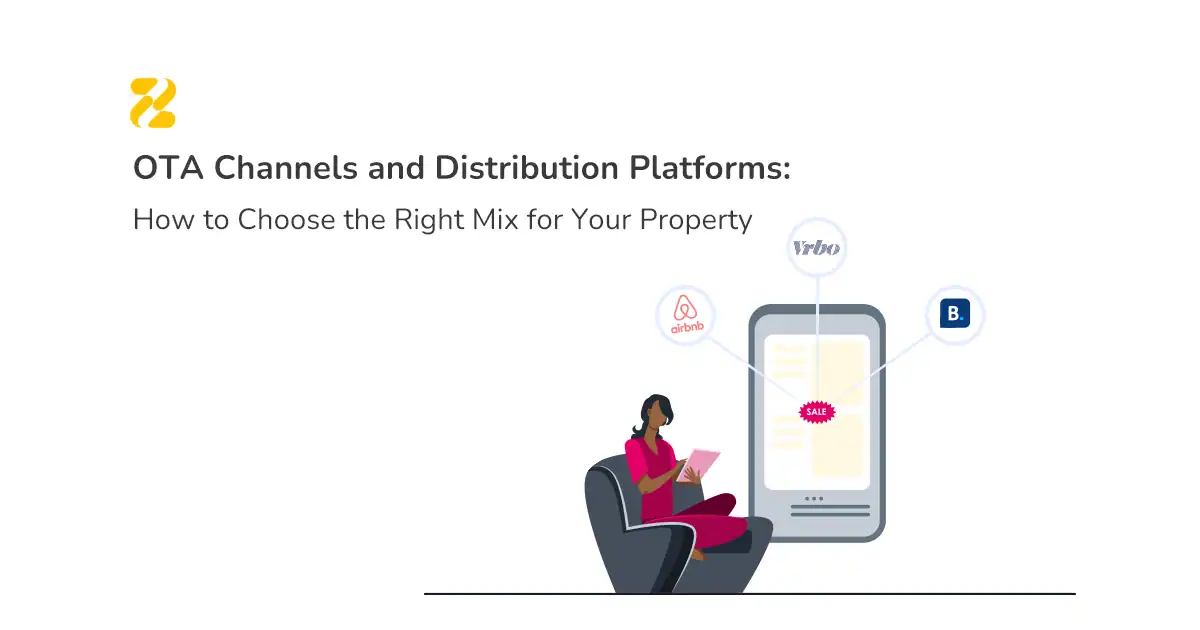
For UK operators with a mix of city flats, rural retreats and serviced apartments, this is what makes it possible to list widely without multiplying the admin. Not sure which channels deserve a place in your mix? Our guide to choosing the right OTA channel mix is a good next read.

API vs iCal: How Does an Airbnb Channel Manager Connect to Your Channels?
API connections are direct, two-way links between your channel manager and the OTA, and they update in near real time. iCal is a calendar feed that the receiving site checks on its own schedule, so updates lag. According to Airbnb’s help centre, a connected calendar refreshes about every three hours, and some hosts report longer delays.
API vs iCal at a glance
| API connection | iCal feed | |
| How it connects | Direct two-way link between the channel manager and the OTA | A calendar link (.ics file) that one site imports from another |
| Update speed | Near real time, according to channel manager vendors | On the importing site’s schedule; Airbnb’s help centre says about every three hours, and hosts report longer |
| What syncs | Availability, rates, restrictions, bookings and, on many connections, listing content | Blocked dates only. No rates and no listing content |
| Direction | Two-way | Usually one link per direction, so two-way needs a pair of links |
| Double-booking risk | Low while the connection is healthy | Higher during the lag window, especially on busy weekends |
| Best for | Several channels, several properties, dynamic pricing | One or two listings on two platforms, or a niche site with no API |
What does that mean in practice?
- iCal cannot carry rates. You would still reprice by hand on every channel, which is where the errors creep in.
- Chained calendar links are fragile. Hosts commonly report that when Vrbo blocks out the following year on a listing linked to Airbnb, those dates get blocked on Airbnb too, even though nothing was booked. Someone then has to clear the blocks by hand.
- It is not either/or. The strongest setups use API connections for the channels that bring most of your bookings and keep iCal as a fallback for smaller or niche UK listing sites.
Before you commit, ask every provider which of your channels are API-connected and which are iCal-only. Zeevou’s channel manager offers two-way sync on supported channels, with iCal import and export for sites that do not offer an API.
Why Do Double Bookings and OTA Sync Problems Happen?
Double bookings almost always come down to a sync gap. A night sells on Booking.com at 6pm, but Airbnb still shows it as free until it is told otherwise. The more OTAs you list on, and the more of them you manage by hand, the bigger that gap gets.
The cost goes beyond an awkward conversation. A double booking can mean a last-minute refund, a scramble to rehouse the guest and a damaging review, all of which a properly configured channel manager is designed to prevent.

UK Multi-Property Example: One Portfolio, Four Channels
Here is an illustrative scenario, not a customer case study, to show what changes at portfolio scale. A UK operator manages 18 units and sells on Airbnb, Booking.com, Vrbo and their own direct booking website.
The portfolio
| Properties | What they need | Why it is hard by hand |
| 8 city-centre flats in Manchester | Fast-moving midweek and weekend demand, same-day changeovers | A double booking leaves no gap to fix it before the next guest arrives |
| 6 cottages in the Cotswolds | Weekend and summer demand, long lead times | Each rate change must reach every channel, for every cottage |
| 4 lodges in the Lake District | Peak school-holiday demand, high nightly rates | One wrong rate on one channel costs the most here |
One Friday afternoon, with a channel manager
- A guest books a Lake District lodge for a long weekend on Booking.com.
- The channel manager closes those nights on Airbnb, Vrbo and the direct booking website straight away.
- The booking and the guest’s messages arrive in the same inbox as every other channel, and the stay appears on the booking calendar.
- A per-channel mark-up keeps rates on each OTA high enough to cover that channel’s commission, while the direct website stays at the base rate.
Now imagine the same Friday with calendars linked by iCal. If Airbnb refreshes every three hours, as its help centre describes, an Airbnb guest can book that lodge for the same nights in that gap. The operator then pays for a refund, finds the guest somewhere else and risks a one-star review.
The lesson is simple: the more properties and channels you add, the more a missed sync costs, and the more you need a calendar view built for portfolios. That means separate views for bookings and for rates and availability, so 18 units stay readable instead of becoming a wall of colour.
How Do You Choose the Best Channel Manager for Airbnb? A UK Checklist
The best channel manager for Airbnb is the one that connects to the channels you actually sell on through proper two-way connections, copes with your number of units and ties into your own direct booking website. Use these eight questions to compare providers, Zeevou included.
Airbnb channel manager checklist
| Check | Ask the provider | Good sign | Red flag |
| 1. Airbnb connection | Is Airbnb connected by API through an approved partner, or by iCal? | API, and the provider appears in Airbnb’s partner list | iCal only for Airbnb |
| 2. Channel coverage | Which of my channels are API-connected and which are iCal? | A clear list, channel by channel | A big channel count with no API/iCal split |
| 3. Sync reliability | How quickly do changes reach each OTA, and how will I know if a sync fails? | A visible sync status and an alert when something fails | You find out when a guest complains |
| 4. Rates, content and pricing tools | Does it push rates, photos and descriptions, and work with my pricing tool? | Rates and content both sync, and pricing tools connect | Dates only |
| 5. Multi-unit calendars | Can I see bookings and rates and availability in separate views at 20+ units? | Dedicated views for each | One long list that breaks as you grow |
| 6. Per-channel mark-ups | Can I set a mark-up per channel to cover commission? | Yes, per channel | One price everywhere with no control |
| 7. Direct booking | Does my own website use the same live availability? | One shared inventory | A separate system you have to sync yourself |
| 8. Onboarding and pricing | What does migration cost, and is pricing per unit, per channel or per booking? | Guided migration and transparent pricing | Commission added on top of the subscription |
Which setup fits your portfolio?
- One or two listings on two channels: iCal may be enough if you accept the delay and are happy to reprice by hand.
- Three or more channels, or more than a handful of units: choose two-way API connections, a portfolio calendar and rate sync.
- Any plan to grow direct bookings: pick a channel manager that shares availability with your own website from day one.
To compare against your shortlist, see how Zeevou’s channel manager answers each of these eight questions, and read our guide to holiday let management software if you are also weighing up a full PMS.

How Does a Channel Manager Help You Win More Direct Bookings?
Once your OTA calendars are reliably in sync, the same infrastructure can carry your direct booking strategy. A direct booking website built on your channel manager shares live availability with every other channel, so you can convert OTA guests with your own offers and no risk of overbooking.
OTAs charge commission on every booking, and rates vary by channel, so check current terms. A direct booking avoids that. Zeevou’s pricing page lists a 0% direct booking fee, which means the saving stays with you to reinvest in guest experience or marketing. For a deeper look, read our direct booking platform guide.
Direct bookings also give you something OTAs do not: guest data. Zeevou’s online check-in captures email addresses and phone numbers, with UK GDPR-compliant marketing consent, so you can build a channel for repeat stays instead of starting from zero with every guest.
None of this means abandoning OTAs. Airbnb and Booking.com still bring the reach and discovery a growing portfolio needs. Use the channel manager to stay visible everywhere, and steadily move a larger share of revenue to the channel you control. Dynamic pricing tools can then use the same synced data, and the same foundation helps you fill the shoulder season with confidence.
FAQs About Choosing a Channel Manager for Airbnb
A channel manager for Airbnb is software that syncs your rates, availability and bookings across Airbnb and your other channels automatically. If you list on more than one site, or plan to, you need one to avoid double bookings and manual calendar work. If Airbnb is genuinely your only channel, it is less urgent, though many hosts still use one to run a direct booking website alongside Airbnb.
It connects to each platform and closes the dates everywhere the moment a booking arrives on any one of them, so a night cannot be sold twice. Without one, a booking on one site takes time to reach the others, and during that gap the same night looks available in two places.
iCal can work for one or two listings on two platforms, if you accept the delay. It only carries blocked dates, and the receiving site refreshes on its own schedule (Airbnb’s help centre says about every three hours). If you manage several properties, sell on three or more channels or want rates synced too, choose a channel manager with two-way API connections and keep iCal as a fallback.
The best channel manager for Airbnb is the one that connects to the channels you actually sell on through two-way connections, copes with your number of units and ties into your own direct booking website. Compare options with the eight-question checklist in this guide, and ask every vendor which of your channels are API-connected and which rely on iCal.
Airbnb channel manager pricing varies by provider and is usually based on the number of properties or units you manage, and some add a commission on bookings, so ask. Zeevou’s pricing page offers a Forever Free plan that includes a channel manager and direct booking website, with paid plans for larger portfolios. Check the pricing page for current plans.
Yes, when it is connected to your own booking website rather than just OTAs. The same live availability that protects your Airbnb and Booking.com calendars powers your site, so guests can book direct with no risk of overbooking, and Zeevou’s pricing page lists a 0% direct booking fee.
Conclusion
A reliable channel manager for Airbnb is the difference between listing confidently across several platforms and double-checking calendars by hand. It starts as protection against double bookings, and the right one becomes the data backbone for your pricing and your direct booking website.
Start by getting your sync right: two-way connections for the channels that matter, iCal only as a fallback, and a calendar built for your portfolio. Then build direct bookings on top.
Zeevou empowers modern property managers to reclaim control of their calendars, automate confidently across every channel and grow direct bookings sustainably. If you would like help mapping your current OTA setup, talk to the Zeevou team for a free consultation, or explore the channel manager first.
Image by pch.vector on Magnific.