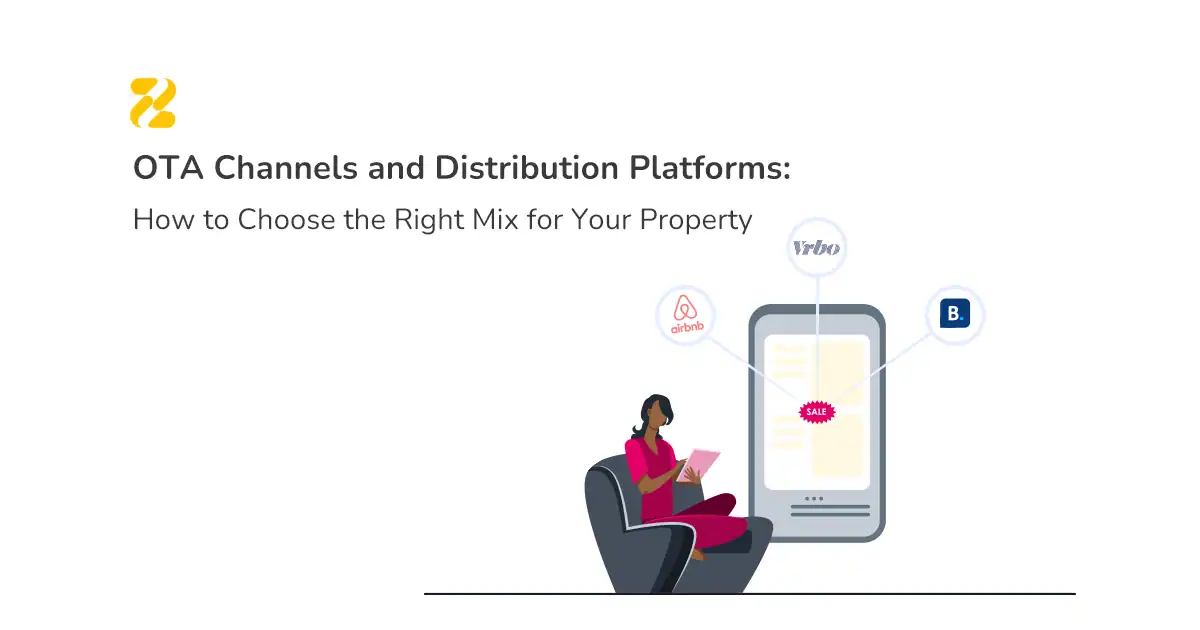
Have you heard of people talking about channel managers, OTAs, iCal and APIs but are not sure what all these terms mean? In this blog post, we aim to give you a brief overview of how channel managers enable you to connect to OTAs via iCal or API. We will also explain what each of these terms means and what the advantages and disadvantages are between the two technologies used to sync calendars up.
Table of Contents
What is an iCal channel manager?
An iCal channel manager is a channel manager that keeps your calendar in sync across Airbnb, Booking.com and other OTAs using iCal, a simple calendar file format each platform can read and update. When a booking comes in on one site, the iCal feed updates your calendar everywhere else, so the same night doesn’t get sold twice. It’s one of two common ways a channel manager connects to OTAs, the other being a direct API connection, which this guide compares below.
What are double bookings, and how does a channel manager prevent them?
A double booking happens when the same night gets sold on two different platforms because the calendars weren’t updated in time. A channel manager, whether it’s syncing via iCal or API, exists to close that gap by keeping every connected platform showing the same availability.
iCal vs API: what’s the actual difference?
iCal syncs on a delay. Most platforms refresh iCal feeds every few hours rather than instantly, which means there’s a window where a booking could still slip through on another channel. An API connection updates in real time, which is why operators managing a larger number of properties, or anyone who’s been caught by a delayed sync before, usually move to an API-connected channel manager once they outgrow the risk of that gap.
How can channel managers offering API connections reduce this risk?
Channel managers can have API integrations with a PMS (Property Management Software), or could be built into one. In the former case the information flows from the PMS to the channel manager, in the latter case it’s all shared in-house. Whichever your use case may be, the interesting question is how channel managers integrate via API connections to the OTAs (often referred to as channels, hence a channel manager).
What is an API? API is the acronym for Application Programming Interface and refers to the language that different apps use to talk to each other. These enable real-time connections and flow of pretty much any type of data. In the context of the synchronisation of calendars across websites used to advertise vacation rentals, this helps reduce overbookings. API connections are usually of one of two types – XML or JSON. These refer to the type of technology used to build the integration. JSON integrations based on RESTful APIs are generally considered to be superior to XML integrations, however some major OTAs, including Booking.com, still run their API on XML, while others like Airbnb and Expedia have moved to JSON/REST.
Using API integrations, a channel manager can actually ‘push’ an update as soon as a change occurs, which vastly reduces the window of time during which a double booking could occur. Moreover, channel managers that integrate to OTAs using API connections can also push pricing across. This means that you can centrally manage your prices, and as soon as you make a change, get it to propagate not only to your direct booking website, but also to all the channels that you are using to sell your inventory. Say, for example, you find out that a major event has just been announced for your town and you would like to hike the rates. This way, you can quickly and efficiently ensure that your up-to-date prices have been pushed to all websites in the shortest time possible so that you can maximise your income for those days while guests head to their devices to book their stays.
If you want to really become a pro at maximising your occupancy and managing your revenue as efficiently as possible, you may wish to integrate your PMS or Channel Manager to a dynamic pricing software such as PriceLabs or Beyond. This can be particularly helpful if you are working across multiple markets, and are not able to continuously keep an eye out to track how the market is moving for each location where you have a property under ownership, arbitrage or management.
Now that you know all about iCal vs API and their connection to channel managers, if you are searching for a solution that will help you achieve all of this, take a look at how Zeevou brings channel management and real-time syncing together. Book a free consultation.